
EPISODE TWO
Aboriginal and Torres Strait Islander people should be aware that this website contains images, voices and names of deceased persons.
Full Episode Transcript: Enemy Alien
Tamson Pietsch: Hello, history lovers. You’re listening to History Lab, and I’m Tamson Pietsch from the Australian Centre for Public History and UTS Impact Studios.
This is the second episode in our three-part series on how bureaucratic systems have profound effects on human lives. We recommend listening from the start. In the first episode, we heard stories of people trying to escape escalating oppression as fascism and war spread throughout Europe in the lead up to World War II. The mundane reality of fleeing increasingly dire situations involved filling forms and writing letters, attempting to meet complicated and often arbitrary eligibility requirements set by different countries.
It was bureaucratic violence, and the result for many was an untimely, violent death. For the few who came to countries like Australia, bureaucratic violence restricted their ability to reestablish their careers and thrive in their new homes and communities.
In this episode, we’ll hear about a new category imposed upon people during the Second World War, the enemy alien. We’ll meet a man called Leonhard Adam, who is thrust into that category even as he’s fleeing Nazi persecution.
First, a non-Aryan, then an enemy alien, Adam’s life is irrevocably altered by ever-changing bureaucratic categories. Our story begins in England at the outbreak of the war, when the fear of treachery has reached fever pitch. As the United Kingdom declares war on Germany, a new wave of bureaucratic violence is unleashed on the home front.
On The Home Front – 1940 (Archive Video): Let no one say that Britain is unprepared in the grave hour that is at hand. Barbed wire and other defenses appear in the streets of London to guard important centers to defeat fifth columnists and any other enemies working among the civil population. And it’s the same stories of these new defenses from all over the country.
Katherine Biber: In the lead up to the war in Great Britain, there was this intensifying moral panic about traitors in our midst. MI five is taking this situation seriously. The government is taking it seriously and people are wanting to dob in strangers, dob in their neighbors, and accuse them of being either Nazis or communists.
It was given a label of the fifth column, and the fifth columnists were people who were traitors.
Josh Bornstein: That’s Katherine Biber, the legal historian from UTS we heard from in episode one. She and her team have been researching the lives of lawyers who left Europe to escape the rise of fascism from the early 1930s.
Many of those people, most of them Jewish, had gone to England
On The Home Front – 1940 (Archive Video): much more tragic is the continued story of refugees arriving in Britain. Just try to imagine what they’re feeling. For days and nights, they have been fleeing almost continuously harassed by Nazi bombs and machine gun bullets. Now, for the moment, they know they are safe behind the allied armies, but even here they realize that for the time being, the tide of Nazi brutality sweeps forward.
Katherine Biber: When the war is declared, in September of 1939, there are 70,000 German nationals living in Great Britain.
Neville Chamberlain (Audio Archive): This is London. You will now hear a statement by the Prime Minister.
This morning the British Ambassador in Berlin handed the German government a final note stating that unless we heard from them by 11 o’clock, that they were prepared at once to withdraw their troops from Poland, a state of war would exist between us.
I have to tell you now that no such undertaking has been received and that consequently this country is at war with Germany.
Katherine Biber: And all of the aliens in Britain who are of German nationality immediately become enemy aliens.
BBC News Archive: Sir John Anderson’s first task in Parliament as the new home secretary and minister for home defense was to announce that all Germans and Austrians in this country will be examined immediately. Examiners will sit in London in the provinces to decide who shall be interned or otherwise restricted. He said that all aliens who might be hostile to this country must be rendered harmless, and all enemy aliens over 16 and British-born women who became German or Austrian by marriage must now report to the police.
Katherine Biber: Shortly afterwards, a tribunal system is established to classify these enemy aliens and they create three categories, A, B, and C.
Category A are people who are actual national security risks. Category B is people who are allowed to be at liberty, but they’re restricted and subject to surveillance. And category C are the so-called friendly aliens and category A, people are immediately arrested and interned.
Josh Bornstein: Many of these people were actually victims of Nazism seeking refuge in England, but the British authorities didn’t make an exception for them. They were categorized as enemy aliens along with anyone who might be a Nazi sympathizer, a spy, or a fifth columnist.
Katherine Biber: What we see here is the classification or categorization of human beings into a system that will have huge human consequences for them, and we can use the term bureaucratic violence to describe this process.
Winston Churchill (AI generated audio likeness): We have found it necessary to take measures of increasing stringency, not only against enemy aliens and suspicious characters of other nationalities, but also against British subjects who may become a danger or a nuisance should the war be transported to the United Kingdom.
Katherine Biber: Eight months later, Churchill becomes the Prime Minister. That’s in May of 1940, and he decides to intern all of the men in category B. So anyone who’s a male between the ages of 16 and 60, who was in category B, which was previously at Liberty, but subject to surveillance, they become subject to internment.
And that’s a huge number of people.
Winston Churchill (AI generated likeness): I know there are a great many people affected by the orders which we have made who are the passionate enemies of Nazi Germany.
I am very sorry for them, but we cannot at the present time and under the present stress draw all the distinctions which we should like to do.
Katherine Biber: The way that Churchill starts to rationalize that we’re gonna be interning a lot of people who are not, in fact our enemies, is that actually it’s gonna be a lot safer for those people because there’s hostile public sentiment in English society about German nationals, and those people are gonna be safer in interment.
It’s important to say that a lot of the German nationals who are in England at this time are either Jewish or they’re political opponents of the Nazi regime, and those groups would’ve been locked up in Germany as well.
And of course, bureaucratic violence operates across a spectrum, and one at the end of the spectrum, we have the kind of dirty, degrading, inhumane conditions of internment and at the other end of the spectrum, we end in mass death.
On The Home Front – 1940 (Archive Video): More classes of German and Austrian aliens have been interned. It’s hard luck for those who are genuine refugees from the Nazis. But let them realize that these measures are absolutely essential, and those internees who [00:08:00] are put to unnecessary hardships should remember that the allies are fighting to be able to send them back free men to their own countries.
And if their share of the burden of this struggle, is it they must live in an internment camp, they must bear it without murmuring.
Katherine Biber: And the internment camps that they’re using in Great Britain, they’re basically taking over kind of holiday camps, army barracks, industrial warehouses. They become overcrowded. And so they have this problem, what are we gonna do with all of these enemy aliens that we’ve interned?
We haven’t got space for them. So they decide to start sending them by ship to other countries that share the same policies. And Canada is one of those countries and Australia is one of those countries.
Mary-Clare Adam: So the journey began the 10th of July, 1940, 10th of July till the 3rd of September on that awful ship. My father only said Dunera was a hell ship. He used to call it the hell Ship Dunera, but he didn’t elaborate.
Josh Bornstein: That’s Mary Clare Adam. Her father, Leonhard Adam, was interned in Britain on the Isle of Man before being loaded onto a ship called HMT Dunera with around two and a half thousand other internees, all males aged 16 to 66.
Several of those men had just days earlier been aboard a ship full of internees heading to Canada that was torpedoed by the Nazis and sunk. More than 800 died, and those that survived were returned to England to be put on the Dunera to sail to an undisclosed location.
Mary-Clare Adam: My father’s first training was as a lawyer and he worked in the legal office of the local section of Berlin where he was, which was Berlin Shattenberg. And then he became an assistant judge in that court.
Josh Bornstein: He was also a skilled and prolific painter.
Mary-Clare Adam: He didn’t keep an actual written diary, but he kept a diary through his paintings and he did wonderful watercolors of actually all the stages of his life. I mean, a beautiful bridge in Berlin with gorgeous green trees and flowers and whatever. Berlin itself and. Lots of England in the thirties, gorgeous paintings. And optimistic and lovely.
Josh Bornstein: Leonhard Adams’ father was Jewish, and so Nazi racial exclusions meant Leonhard was not able to work as a lawyer or a judge or work in academia. He fled to England in 1938 and began rebuilding his career. As well as his legal work, Adam was an anthropologist with a keen interest in the legal systems and cultures of Aboriginal people, a field then known as primitive law. He was made a fellow of the Royal Society of Arts, where he gave lectures and seminars, and he had a part-time job at the University of London.
Mary-Clare Adam: He was actually very happy living in England. His brother came about six months later. They rented an apartment there and I actually found it and it’s opposite one part of Hampstead Heath. Very nice. And they were happily living there until suddenly in May of 1940, Winston Churchill decided that every single person who came from Austria or Germany or any part of former Germany could be or was a Nazi spy, and they had to be arrested. And as you know, Churchill said collar the lot.
Josh Bornstein: Leonhard Adam was swept up in a series of hasty bureaucratic decisions being made as the war escalated.
Sara Dehm: At the outbreak of war, Adam was classified as Category B, which meant he was exempt from internment and was able to be released subject to certain restrictions. He then had to appear before a committee again at the start of May of 1940, and he had that category B status affirmed.
Josh Bornstein: That’s Sara Dehm from UTS, part of the team researching the lives of lawyers who left Europe around the Second World War.
Sara Dehm: But because of the German invasion of France and the Netherlands, and other parts of Europe at the start of May in 1940, that’s when Churchill made that abrupt change in policy such that all category B people were subject to arrest and internment.
Josh Bornstein: Leonhard Adam was arrested on the 16th of May 1940.
Newspaper Archive:
Birmingham Mail, Thursday, 16 May 1940.
Police mobile fleet collects aliens. The roundup began in London immediately after the Home Secretary’s order. The greatest secrecy was maintained until it was actually in progress. Practically the whole of Scotland Yard’s mobile fleet was mobilized to collect the aliens, who will be taken to an internment camp near London. At Sheffield, two motor coach loads of aliens were rounded up.
Sara Dehm: it shows how these very arbitrary categories don’t reflect the realities or the complexities of people’s lives. Or even people’s political sentiment either.
Josh Bornstein: Adam was put in an internment camp on the Isle of Man. Almost three months later, a woman named Esther Simpson received a letter from the camp, and she realized she should have made more efforts for him earlier.
Carl Wehner (voice actor):
Dear Miss Simpson,
Dr. Leonhard Adam and his brother left for overseas, either Canada or Australia. They were not told whether.
Yours sincerely, Carl Wehner. Ninth of August, 1940.
Josh Bornstein: Esther Simpson had been working for the Academic Assistance Council in the UK since 1933. Like Camilla Wedgwood, who we heard about in the first episode, Esther Simpson worked tirelessly to help people fleeing fascism in Nazi Germany. The council focused its efforts on academics and also, like Wedgwood, worked with limited resources in the face of thousands of requests.
By the outbreak of the war, the council had rescued around two thousand people. Later, it became known as the Society for the Protection of Science and Learning, and still exists to this day as the Council for At-Risk Academics. In the months leading up to his arrest, Adam had been writing letters and making requests for jobs and support throughout his networks, including the Academic Assistance Council.
Esther Simpson and the council had a hard time keeping track of Adam after his arrest. At each point, it took months to find out where he was. From an internment camp on the Isle of Man to the HMT Dunera sailing to no one knew where Even the men aboard this ship did not know their final destination.
Mary-Clare Adam: They were all told they were going to Canada, but then the ship, instead of going straight across the Atlantic, turned down the coast of West Africa.
And he said when it came off the coast of Sierra Leone, he said, they’re taking us, I’m sure, to their former penal colony of Australia.
Josh Bornstein: It turns out Adam knew quite a bit about Australia
Mary-Clare Adam: They gave lectures on the ship, on the Dunera. He started giving lectures about Australian tribal law that he’d learned from Roland Carter.
Josh Bornstein: During the First World War, Leonhard Adam had been part of a project that recorded interviews with prisoners who’d been captured by the German army. That is where he met Roland Carter.
Ana Vrdoljak: Roland Carter was a Ngarrindjeri man from Port McLeay mission in South Australia. He, like so many Aboriginal people at that time, was removed from his traditional lands and put on another part of Country. And enclosed in those missions they couldn’t leave their lives were controlled by the states, including curfews and permissions to leave for work and so forth. So , First Nations peoples were subjected to the bureaucratic violence of the Australian state in a very different way, but also in very similar ways to the people that we are looking at in this podcast series.
Josh Bornstein: Ana Filipa Vrdoljak is professor of law at UTS and part of the project looking at the lives of lawyers who fled fascist Europe and ended up in Australia.
Ana Vrdoljak: He, despite all that, still enlisted in the Australian imperial forces to go fight in the First World War on behalf of the British Empire as it was then, he was injured in France and was taken to a German POW camp. And it’s here that he comes across Leonhard Adam.
Leonhard Adam (voice actor): I had not originally intended to include the second Australian, Roland Carter, in the investigations at all. Although possessing the unmistakable racial characteristics of the Australian native, this tall and handsome young man was of a lighter brown complexion than Douglas Grant. He was a half-caste, a horse trainer by profession, and certainly had the lifestyle of a young man devoted to sport by playing football with his friends from morning till night. But here I received a pleasant surprise in a different way. After listening to my conversations with Grant several times, Roland Carter offered, of his own accord, to give me his reports on the natives of Lake Alexandrina.
(Leonhard Adam’s article is also read in German)
Ana Vrdoljak: Leonhard Adam at this time was involved in an ethnographic project designed to collect information about the cultures and the customs of prisoners of war from British imperial forces. Leonhard Adam was also interviewing Gurkhas and Indians.
Roland Carter actually approached Leonhard Adam in the camp rather than the other way around, during this process of interviewing the prisoners of war. It clearly was a detailed amount of information that he gave Leonhard Adam from ceremonial practices to initiation ceremonies of his community back home.
Josh Bornstein: Adam wanted to build understanding of Aboriginal customs and laws among European readers. In 1927, he published an article in a German law journal documenting what he’d learned from Roland Carter. But while Adam’s scholarship centered First Nations knowledge, European powers and the discipline of anthropology were still largely committed to colonialism.
Ana Vrdoljak: Knowledge of these colonial peoples was vital for colonial powers. To understand how they’re thinking, how they were able to be potentially assimilated, they wanted to understand colonized peoples and peoples in colonial territories of other colonial powers like the British Empire.
Josh Bornstein: Adam was arrested in May. The Academic Assistance Council heard that he’d left internment on a ship in August, and it was more than six months later that they received a letter telling them Adam was in a camp in Australia in a small town called Tatura on Yorta Yorta country in rural Victoria.
Robert Marett (voice actor): March 17, 1941.
Dear Madam, curiously enough, since receiving your letter of March 13 concerning Dr. Leonhard Adam and replying thereto, I have today had a letter from him dated December 14 in answer to mine of July 14 and written from Australia where he is now interned. I had supposed him to be in the Isle of Wight.
His address is Dr. Leonhard Adam, Internment Camp No. 3, Tatura, Victoria, Australia.
Cinesound newsreel archive 1940: From an overseas liner in Sydney Harbor, a strange contingent of new arrivals is transship to board a ferry. Enemy aliens who are being interned in Australia for the duration of the war. What thoughts must be theirs as they’re taken ashore in a new world of sunshine and freedom?
This trainload of enemy aliens sets out to a haven of safety for the duration. That’s certainly a contrast. It’s also the fortune of War.
Josh Bornstein: Adam was becoming an eminent anthropologist associated with some of the most reputable institutions in Europe at the time. Penguin had just published his book on what was then known as primitive art. Australia had just six universities, a handful of museums, and no reputation for scholarly work.
It was likely the last place he’d have wanted to go
Katherine Biber: There is an irony that many people who would’ve wanted to come to Australia for safety at this time were not allowed. Our migration policies would not have allowed any of these people simply to migrate here for their safety. But nevertheless, they came here against their will.
Josh Bornstein: Adam was becoming an eminent anthropologist associated with some of the most reputable institutions in Europe at the time. Penguin had just published his book on what was then known as primitive art. Australia had just six universities, a handful of museums, and no reputation for scholarly work.
It was likely the last place he’d have wanted to go
Katherine Biber: and, you know, there were about 2,500 passengers on the De Nira of whom about 900 stayed in Australia after the war. So these were kind of unwilling migrants who Australia nevertheless kept after the war who would otherwise not have been permitted to enter Australia under other circumstances.
Josh Bornstein: A few weeks after the Dunera set sail, the UK’s Home Office released a white paper that identified 19 categories of internees made eligible for release. [00:25:00] It included people who could prove they were anti-Nazi and anti-fascist
Sara Dehm: So basically victims or refugees of Nazi oppression.
Josh Bornstein: UTS academic Sara Dehm
Sara Dehm: The UK in its guidance to Australia around interning the people who arrived on the Dunera, recognized that because of the hasty way that these people were classified, that there would be refugees from Nazi oppression among them. And recommended that Australia should engage in reclassification of people upon arrival, and also that Australia should treat any refugees of Nazi oppression with leniency and sympathy. Australia, though in response, said that it had security concerns and also it didn’t have enough information at its disposal in order to engage in reclassification because they didn’t know really anything about the people that were arriving. Australia was very worried about public sentiment. And that meant that even though the British and Australian authorities acknowledged that there were Jewish refugees of Nazi oppression amongst the Dunera arrivals Australia was not prepared to release them.
Josh Bornstein: Had Leonhard Adam not been on the Dunera, he would probably have been released from the internment camp on the Isle of Man, free to live in London again. But Australia was not willing to release these people unless they returned to England, which meant braving a long sea journey while war was spreading around the globe
Sara Dehm: at this point in time in Australia there is on the one hand, a lot of public sentiment supporting increased internment of German and Austrian nationals. And there’s, op-eds in the paper calling for a broader internment policy, but there’s also a concerted movement for people’s release as well. So there’s this sort of tension playing out in public debate.
ARCHIVE propaganda: Australia is free. Perhaps in the past too free. Government officials day and night are working to stamp out this enemy within. We as loyal citizens must also do our part. We can assist to stifle this cankerous evil.
Josh Bornstein: As well as the people classified as enemy aliens who arrived from the UK, anyone already living in Australia with German or Austrian heritage was liable to be interned. As the war progressed, the category of enemy alien expanded to include Italians and Japanese people as well.
ARCHIVE propaganda: Even away in the little known interior, there are townships where agents of Hitler wait an plan for the downfall of a country that has sheltered them and given them security.
In return for freedom and safety under the British flag, every alien is required to satisfy the authorities of his bonafides. He must tell of his plans and proposed movements. The commonwealth must be sure this country is at war. War as real as that in Europe.
Josh Bornstein: As well as the people classified as enemy aliens who arrived from the UK, anyone already living in Australia with German or Austrian heritage was liable to be interned. As the war progressed, the category of enemy alien expanded to include Italians and Japanese people as well.
Katherine Biber: In legal theory, there is this big debate or divide between, on the one hand, what’s called legal positivism, and on the other hand what’s called natural law or natural law theory. Legal positivism is the idea that law is made by human beings, and that whatever the law is, whatever the sovereign or the state or the people have determined should be the law. That is the law. And whether it’s fair or whether it’s just, or whether it delivers good outcomes, it doesn’t matter. It’s lawful. We call that legal positivism.
And under natural law theory, when we’re deciding what is the law, we have to look at what is ethical, what is moral, what is the underlying morality of what we’re trying to achieve, not just what is the law on the books.
On The Home Front – 1940 (Archive Video): More classes of German and Austrian aliens have been interned. It’s hard luck for those who are genuine refugees from the Nazis. But let them realize that these measures are absolutely essential.
Katherine Biber: It’s important to know that these theories and this debate between natural law and positivism is unfolding in the actual moment where it really affects people’s lives.
So even though we call these legal theories, these have material realities for the people who are living through these moments. Because we know that after the second World War, war crimes, tribunals were established and at the heart of all of the war crimes tribunals was the question, what actually is the law? Because all of the defendants were saying, what we did was lawful. All we were doing was enforcing the law. And the prosecutors were saying they were unjust laws, they were immoral laws. You should have known those laws should not have been obeyed. And so the debate about natural law and positivism, and the debate about the rule of law and the state of exception. They’re not abstract principles. They’re absolutely connected with the lives and the deaths of the people that we’re researching.
And they’re ideas that are being shaped at the exact same time and by the exact same people who are being set in motion by the Nazi rise to power.
Josh Bornstein: On board the Dunera, the transportees also considered these questions. Many had suffered under new Nazi laws. On the ship, they held lectures on law and philosophy. Some even drafted their own constitution. And when they were held in an internment camp, some of their Australian guards appeared to be questioning whether they should treat these seemingly innocent prisoners by the book or with a more humane approach.
Katherine Biber: A lot of the people who were. interned in Tatura and the other Australian camps talked about the way that the Australian guards and authorities treated them. And most of them described being treated with kindness, and that there was some kind of acknowledgement that these people were not actually enemies, they were not dangerous. So there’s an example where someone wanted to go for a swim, and so the guard just let him have a swim in the river whilst he sat and had a smoke.
Josh Bornstein: Nevertheless, they were held behind barbed wire and under the constant surveillance of guards in watchtowers. The climate was harsh, the flies were relentless, and close quarters amplified otherwise ordinary interpersonal conflict. What’s more, there were Nazis among the internees mixed in with those who had fled Nazism. And yet some of the internees set themselves to building communities within the barbed wire fences
Katherine Biber: it becomes clear quite early on that the internees in the camps are fit for autonomy, and so the Australian authorities give them the autonomy to establish their own leadership systems. They establish a government. All of the different political parties are represented in the Camp Internees. They’re hugely diverse in their political adherence in the camp.
They all have different jobs in the camp, and they also establish trade unions. They have musical ensembles, they have reading groups, they have artistic studios. They have a trade school, they establish a university, and so they occupy themselves in all of these different ways because these are people who have all of these capabilities. And so they’re trying to create a world and populate a world within the confines of an internment camp.
Josh Bornstein: There were a lot of young men and teenage boys in the camp.
Katherine Biber: The older internees, they feel a sense of responsibility to these younger internees to not allow them to lose track of their education. So there’s a lot of effort given to teaching them what they might need to matriculate to qualify for university, to enter trades.
Josh Bornstein: Having improvised educational institutions in internment camps back in England as well, the internees set up a camp university called Collegium Taterense. Leonhard Adam took on an administrative role and also taught jurisprudence, tribal art, and Mandarin Chinese.
The internees were receiving help from welfare and advocacy organisations to access books and teaching materials. Those groups were trying to make day-to-day life better for the internees. They were also lobbying the Australian government for their release.
Katherine Biber: There were lots of different groups and the reasons that they advocated against the policies reflected the ideologies or beliefs of the groups. One of those active groups was the Society of Friends or Quakers. They held humanitarian beliefs that justified their campaign against the exclusion of Emigres fleeing persecution. I don’t wanna suggest that they were the only group who were opposing Australian policies, or who were speaking up against Nazi policy and Nazi persecution at the time.
Josh Bornstein: They were, however, meticulous in their record keeping
Katherine Biber: different archives in Australia hold different papers associated with the Society of Friends or specific individuals who are members of the Society of Friends and whose papers are held in public collections.
And they are a rich and moving and large body of paperwork and correspondence that gives a really detailed insight into what some people did to completely throw all of their energy and effort and love into trying to save and support others.
Josh Bornstein: Fulfilling the internees’ requests often required patience, skill, and perseverance.
Katherine Biber: They are corresponding with individuals who want to be rescued or want them to rescue one of their loved ones, but they are also doing a huge amount of correspondence that’s necessitated by the bureaucracies of rescue and support, and also just the minutiae of these people’s lives. So every permit someone needs, every payment someone needs for the permit, every pair of underpants someone needs, every time someone wants to read a book or wants to make a phone call, or wants to find their lost luggage, or wants to track down their relatives , all of that is documented.
And so the scale of this bureaucratic endeavor is intensified by how many steps there are in every process, and as well as every letter or note or telegram that’s sent about.
Someone has requested a book and they’re in an internment camp. Someone bought the book. Has someone sent the book? Have they received the book? Have they actually got the book? Has it been given to them? Oh, have they acknowledged the book?
But as well as doing all of that work, the Quakers are also advocating with the Australian government about their classification and they’re saying, could we please change this friendly and unfriendly alien classification? A huge number of people are being caught up on the wrong side of friendly or unfriendly. The administration and bureaucracy that these people are dealing with is enormous, but also the scale of it and the nature of it after a certain amount of time starts to feel oppressive and violent in itself. If you have to go through this amount of bureaucracy and surveillance to get a clean set of underpants, it probably does feel like another form of violence or hostility.
Josh Bornstein: While Adam was in Tatura he’d also been trying to get out of the camp and had reconnected with Esther Simpson from the Academic Assistance Council back in the UK.
Katherine Biber: The British advocates for refugees know that it’s really hard to advocate for the people who’ve been transported to Australia for their release from internment because if they are to be released from internment, logistically it’s not possible to bring them back to England now because there’s a war on, it’s not safe and there’s not transport.
Josh Bornstein: Finally, in July 1941, ten months after he’d arrived at Tatura, Adam received the letter he’d been waiting for.
Esther Simpson (voice actor):
Dear Dr. Adam,
Many thanks for your letter of May 5th. I see from it that you do not know, or did not at the time of writing, that the Home Office had authorized your release. We appealed for your release from internment as soon as we heard where you were, and I hope it will not be long before you are either back here or able to do useful work in Australia.
Katherine Biber: And he writes to Esther Simpson saying, look, thank you for all the help you’ve given me. I know you’ve gone to a lot of effort for me. I’ve been offered to return to Great Britain and I’ve declined it [ underlay letter and fade up]
Leonhard Adam (voice actor): I was offered to be taken back to England. I declined, however, for three good reasons. First, in my present state of nerves, I could not now stand a long journey overseas. Second, I would under no circumstances be separated from my brother Manfred. Third, I have no job in England.
Josh Bornstein: Leonhard Adam didn’t want to leave his brother Manfred. He’d asked Esther Simpson to help him, but it seems Manfred was not quite as well-connected as Leonhard.
Esther Simpson (voice actor): I’m afraid that at the present time I am unable to do anything on behalf of your brother. We need an account of his career, posts held in his own country, and subsequent scholarly activity. We need also the name and addresses of authoritative colleagues who can testify to his achievements as a scholar.
Ana Vrdoljak: Leonhard Adam was fortunate in that he was able to draw on networks that he had established well before the rise of Nazism in Germany. And he drew on these at every step of the way, and because of his age, he was already established. He had these networks. He had the language skills, he had the developed relationship that he could draw on that other younger people could not have done.
Josh Bornstein: The Australian authorities wouldn’t release Leonhard Adam to remain in Australia unless he had a stable job.
Ana Vrdoljak: He’s reaching out to all of his networks, constantly, asking for them to vouch for him, being of good character, asking to perhaps give him job opportunities.
Esther Simpson, but also Ada Constance Duncan with the Victorian International Refugee Emergency Council, are writing to people here in Australia or in the United Kingdom and also in the United States, looking for places that may be able to take him on so that he can finally leave internment.
Leonhard Adam (voice actor): I pray that the ultimate result may be in the positive, as I feel I cannot stand the strain on my nerves very much longer, and I could be so useful
Josh Bornstein: Eventually, he got a research scholarship at the University of Melbourne that satisfied the Australian authorities. He left Tatura in May 1942, two years after he was arrested in London and almost a full year after the UK authorities authorized his release.
Ana Vrdoljak: Leonhard Adams’ story is extraordinary, but also ordinary. It is extraordinary to think about somebody that wasn’t able to find refuge, having to flee Nazi Germany , being interned in the uk, forced out to Australia , a country that wouldn’t have otherwise received him. on the de Nira, and then also to the internment camp at Tatura.
Looking at his journey, he continues to make contributions.
Katherine Biber: We have this group of people who we can now see were treated unjustly. They were caught up in a moral panic. They were caught up in a bureaucratic category, but even in that moment, they are themselves thinking creatively and critically about how should we organize ourselves? How should we maintain our connection to humanity? How should we fulfill our responsibilities to each other as human beings, even whilst caught up in the most violent, bureaucratic, degrading system that we could imagine at that time.
Josh Bornstein: For some, internment intensified their commitment to a sense of justice. For Leonhard Adam, once released, he returned to his work with First Nations people
Ana Vrdoljak: the way that Aboriginal people were treated was that they were primitive, that they were not civilized people, so they needed to be assimilated. Whereas for Leonhard Adam, Aboriginal culture, including law and customs, was something that was On par with other societies of equal value. And I think that we are still not grappling with that.
Josh Bornstein: Aboriginal art was not valued in Australia at the time. It wasn’t considered to be art at all. But not for Adam and the First Nations people he would work alongside.
Ana Vrdoljak: It was the way that he looked at Aboriginal cultural heritage, which was quite unique in the Australian context. That is that it had a value which was important, that it had potential economic value for aboriginal peoples at a time when their lives and livelihoods were controlled by the Australian state. What he was advocating was that they could have economic independence, through their art and their cultural practices , not in a way that was exploitative, but in a way that they had a capacity to determine their own fate.
Katherine Biber: I did not expect when looking at people who, in the context of the second World War, were forcibly migrated to Australia that we would end up with looking at First Nations law.
When someone like Leonhard, Adam gave us new ways of understanding First Nations laws, cultures, and connections to Country that brings us back to questions about what is law? What is the connection between law and justice? How does bureaucratic process connect us to ideas of efficiency or humanity?
I think all of these kind of legal philosophical questions do have their origins in the laws of first peoples, and I think that’s a nice realization at the end of this episode.
CREDITS
Emergency Exit was written and produced by Olivia Rosenman for Impact Studios. The collaborating scholars were Katherine Biber, Sara Dehm, and Ana Filipa Vrdoljak. Sound design and engineering by Melissa May. Additional research by Eloise Chandler. Emergency Exit was supported by funding from the Australian Research Council.
To see the letters in this episode and to learn more, visit emergencyexit.com.au
Thank you to everyone we interviewed and all the voice actors for this episode, Mary-Clare Adam, Andreas Bork, Alistair Senior, Toni Johnson, and Thorsten Kostulski who also provided invaluable assistance as a talent scout.
ENEMY ALIEN
Leonhard Adam’s life was twice transformed by bureaucratic categories. Declared a “non-Aryan” by Nazi rules, he was forced out of his career and from his home in Germany. He fled to England in search of safety, only to be classified as an “enemy alien”, a category formed in panicked haste as Europe descended into war. Adam was swept up in a wave of mass internment that made little distinction between refugees and real threats.
From there, his world shrank to barbed wire and bureaucracy. Arrested, detained, and then deported on the infamous HMT Dunera, Adam was transported across the world to an internment camp in rural Australia. Yet even within the confines of captivity, Adam refused to be defined by the labels imposed on him. He taught, lectured, and helped build a vibrant intellectual community among fellow internees.
Through Adam’s extraordinary journey, this episode reveals how abstract legal categories can upend lives and how, even in the harshest conditions, people resist, adapt, and hold onto their humanity.
Featured in Episode Two
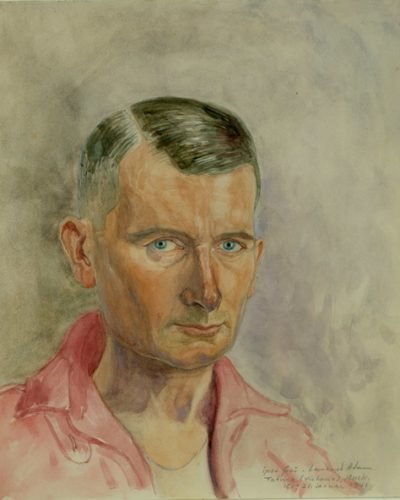
Leonhard Adam
Leonhard Adam (1891-1960) was lawyer and anthropologist, born in Berlin to German and Jewish parents.He studied ethnology and law and is appointed an assistant judge in Berlin after completing his law degree in 1920. He is simultaneously researching and publishing on ‘primitive’ law. He is editor of Zeitschrift für Vergleichende Rechtswissenschaft (Journal of Comparative Jurisprudence) where he publishes his fieldwork on prisoners of war including Roland Carter. Adam is also lecturing on this subject at the Institute of Foreign Law and is on the board of experts of the Ethnographical Museum in Berlin. He is removed from these official positions in 1933. Adam continues to edit the Journal until 1938, when he leaves Germany for Britain. He teaches at the University of London.
Read more
On 16 May 1940 he is interned as an ‘enemy alien’ in Britain and then removed to Australia on the Dunera. Adam’s Primitive Art (1940) is published. He is interned at Tatura in Victoria, with his brother Manfred. He is elected Pro Rector of the ‘Collegium Taturense’ and teaches ethnology and Chinese.
Following extensive lobbying by various organisations including Esther Simpson and the SPSL and Ada Constance Duncan and VIREC, he is released from internment. After being released on parole, Adam takes up a post at the University of Melbourne as a research scholar, lecturer and part-time curator of its ethnological collection. He marries Julia Mary Baillie on 5 June 1943. Adam is naturalised in 1956. He is awarded his doctorate from the University of Bonn the following year. He dies in 1960 when visiting the city for a conference.
Read his biography at the Australian Dictionary of Biography.
Learn more about the Dunera and internment in Australia.
Learn more about the Tatura internment camp.
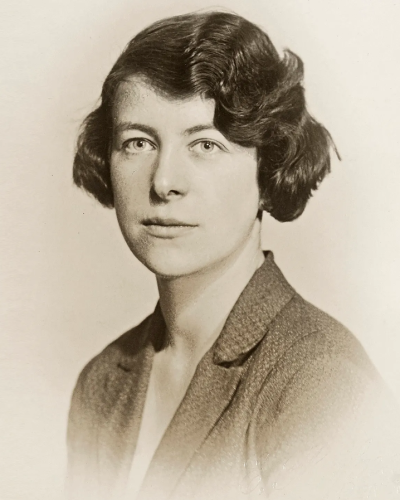
Esther Simpson
Esther Simpson (Sinovitch) (1903-1996) was employed as the assistant secretary of the Academic Assistance Council (AAC) in 1933 helping scholars fleeing Nazi Germany. It was led by William Beveridge, at the London School of Economics. In 1936, the AAC changes its name to the Society for the Protection of Science and Learning (SPSL). Simpson gradually takes on the leadership of the SPSL and by the start of the second world war, has approximately 2000 refugee scholars on her books. In 1940, Simpson and the SPSL assist refugee scholars designated as ‘enemy aliens’ and interned by the British government.
She assisted Leonhard Adam while interned in Britain, removed on the Dunera, and during his internment in Australia.
Read More
In 1999 SPSL is renamed the Council for Assisting Refugee Scholars. Today it is known as the Council for At-Risk Academics (CARA). Papers of the Society for the Protection of Science and Learning are held at the Bodleian Library, University of Oxford.
Papers of the Society for the Protection of Science and Learning are held at the Bodleian Library, University of Oxford.
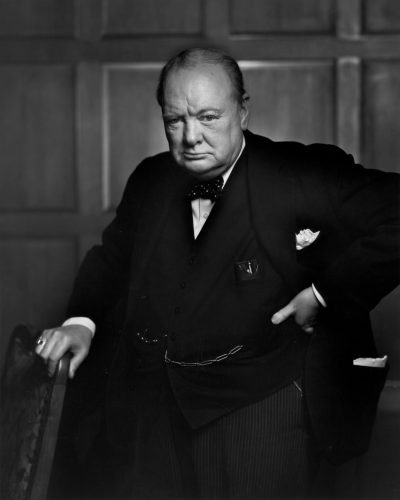
Winston Churchill
Winston Churchill (1874-1965) was the British Prime Minister from 1940 to 1945. He was appointed First Lord of the Admiralty by then Prime Minister Neville Chamberlain when Britain declared war on Germany on 3 September 1939.
He succeeded Chamberlain after the German invasion of Belgium and the Netherlands. He delivered his ‘blood, toil, tears and sweat’ speech on 13 May 1940, his first as prime minister. Read it here.
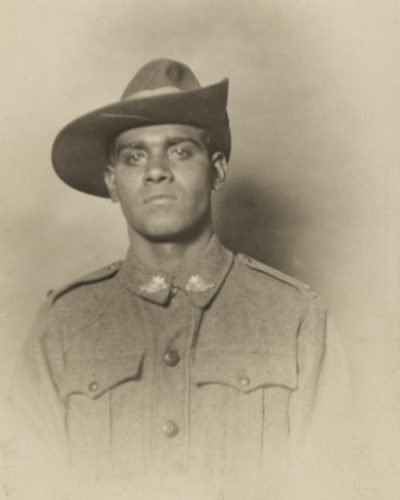
Roland Carter
Roland Carter (1892-1960) Ngarrindjeri man who grew up at Raukkan (Port McLeay Mission), South Australia. The mission was established by the Aboriginal Friends’ Association in 1859. South Australia government took over management in 1916.
He enlisted in the Australian Imperial Force in 1915. He served in Egypt and France 1915-16. He was wounded and captured by German forces at the battle of the Somme on 16 August 1916. He was moved to a prisoner of war camp in Wünsdorf, Germany. He was one of two First Nations men in the camp. The other was Douglas Grant, Ngadjon/Ngadjan man from Queensland. Carter and Douglas were photographed by Otto Stiehl and interviewed by Leonhard Adam. Information from these interviews was published by Adam in Zeitschrift für Vergleichende Rechtswissenschaft (Journal of Comparative Jurisprudence) in 1929, predating the work of the Tindales and Berndts by decades.
Read More
At the end of the war, Carter repatriated to Australia on 20 April 1919 and was discharged on his returned to Port McLeay Mission on 12 June 1919. He received the 1914/15 Star, a British War Medal, and Victory Medal for his service. He married Vera Isobel Rigney and they had eight children. The injury he sustained during the war affected his capacity to work. The Repatriation Commission refused his claim for the condition.
Helen Baillie, Adam’s sister-in-law, who was a member of the Aboriginal Advancement League visited Port McLeay Mission in August 1947. She returned to Melbourne with a letter from Carter for Adam dated 6 August 1947 which stated: ‘I must see you my Friend and I do hope and pray that it won’t be long.’
Carter and Adam never met again in person. Carter died of a stroke in 1960 in South Australia and is buried in Raukkan.
Read his biography at the Australian Dictionary of Biography.
View Glenn Shea, playwright and Julian Meyrick, director speaking about the play Mi:Wi 3027 (2018) about the relationship between Roland Carter and Leonhard Adam
Learn more about the relationship between Roland Carter and Leonhard Adam
Adam, Mary-Clare, and Robyn Sloggett. ‘Roland Carter and Leonhard Adam: Friendship in the Preservation of Ngarrindjeri Knowledge and Cultural Heritage.’ Australian Historical Studies 49, no. 1 (2018): 44–62
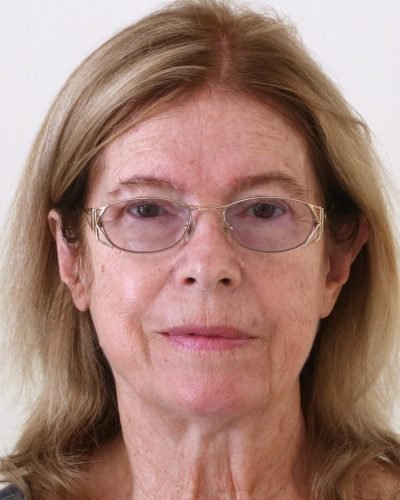
Mary Clare Adam
Mary Clare Adam (b 1945). is the daughter of Leonhard Adam and pianist, Julia Mary Baillie. She resides in Tel Aviv and Vienna.
Artworks of Leonhard Adam
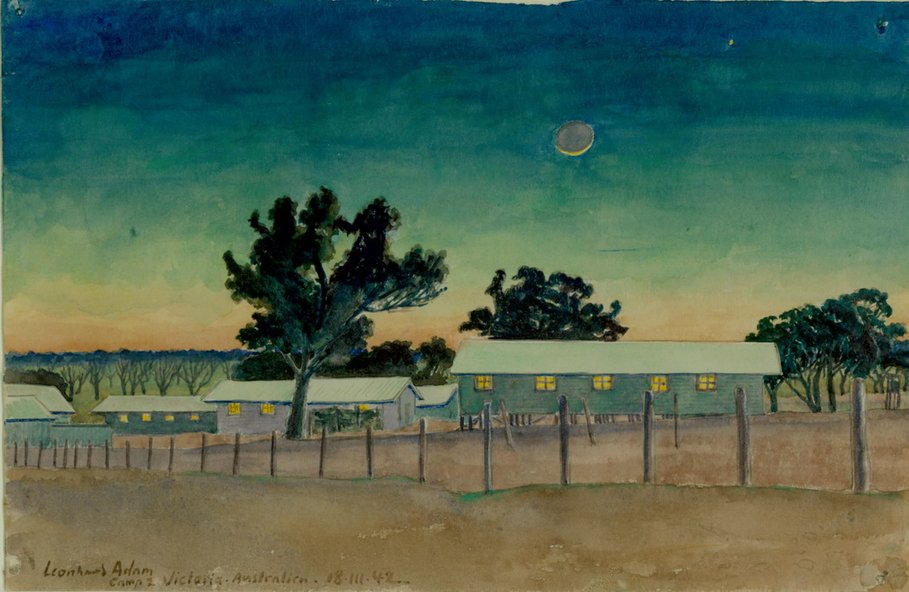
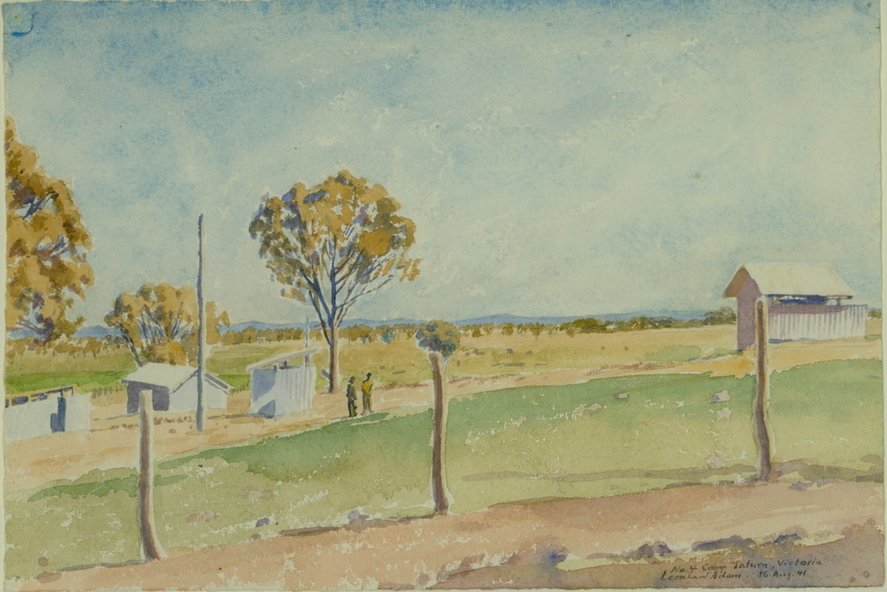
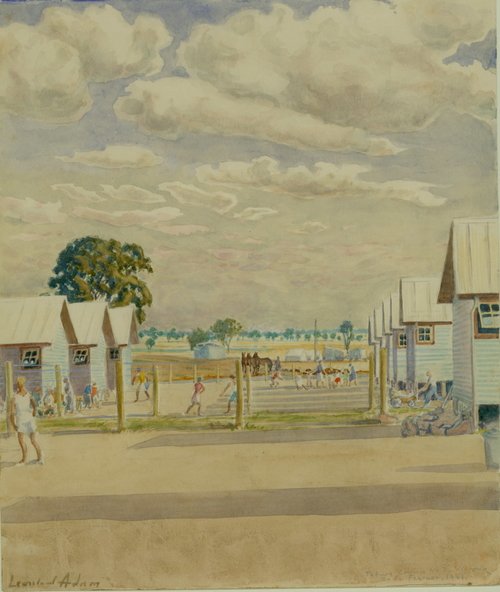
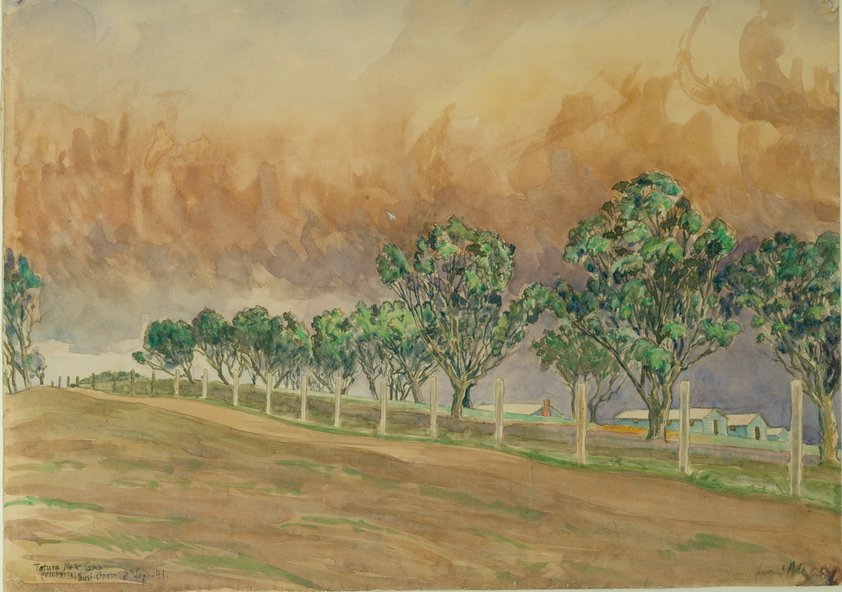
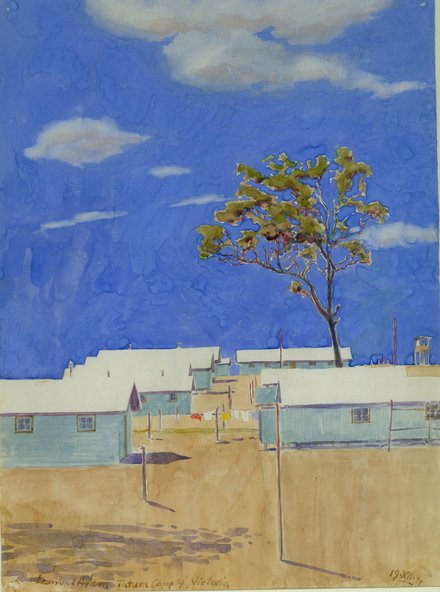
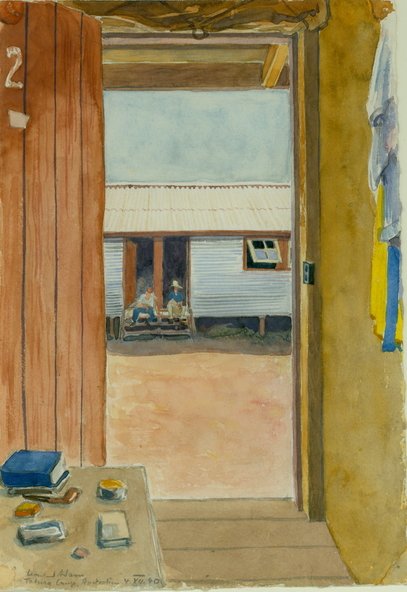
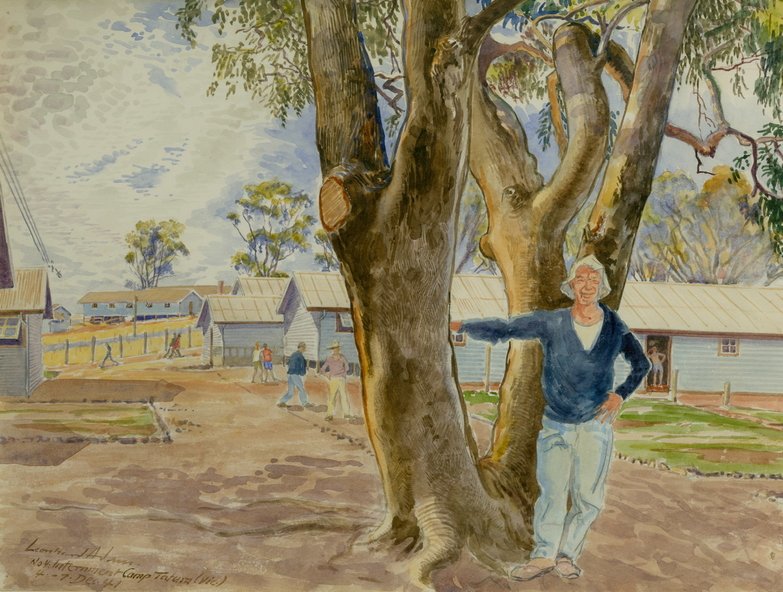
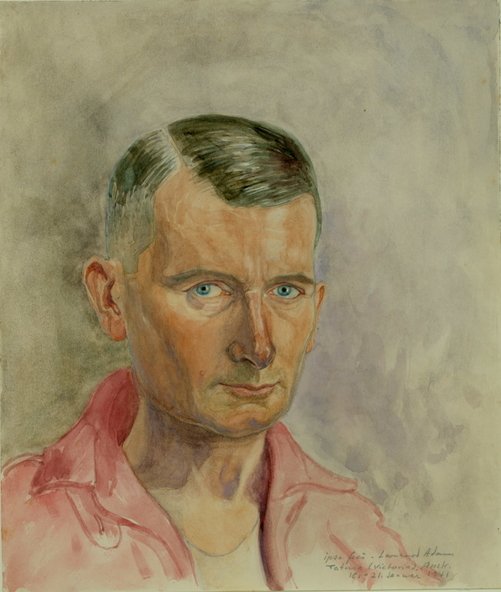
View Adam’s watercolours prepared while in Tatura and held in the Victorian Collection.
Artworks used with permission of Mary Clare Adam and Tatura Irrigation and Wartime Camps Museum.
Episode Credits
Writer and Producer: Olivia Rosenman
Collaborating scholars: Katherine Biber, Sara Dehm, and Ana Filipa Vrdoljak
Additional research: Eloise Chandler
Sound design and audio engineering: Melissa May
Thank you to everyone we interviewed and all the voice actors for this episode. Mary-Clare Adam, Andreas Bork, Alistair Senior, Toni Johnson, and Thorsten Kostulski who also provided invaluable assistance as a talent scout.
The music in this episode included recordings of the Dunera Mass, composed by Max-Peter Meyer on the ship as it sailed for Australia. It was performed by the Luminescence Chamber Singers and The Oriana Chorale, directed by Roland Peelman A.M. with sound engineering and production Jim Atkins. It was recorded at the Wesley Music Centre Chapel in Canberra in 2024 with the support of Creative Australia.
Additional music from Blue Dot Sessions.
Emergency Exit was supported by funding from the Australian Research Council.